Words That Crossed the Water: The Secret Languages Still Alive in Hyde Park's Kitchens
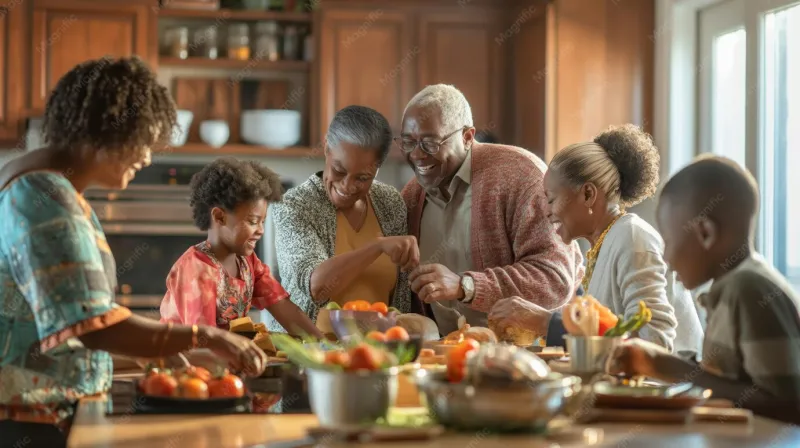
Photo: multigenerational immigrant family gathered around kitchen table talking laughing Chicago, via img.freepik.com
There's a word that Rosa Medina's grandmother used whenever a neighbor showed up unannounced at dinnertime. It wasn't quite Spanish. It wasn't quite English. It was something her family had been saying since before Rosa was born — a soft, compressed little sound that meant something like you're already home here, sit down. Rosa is in her sixties now, and she still uses it. Her kids use it. Her grandkids, who mostly grew up speaking English and scrolling TikTok, use it too, even if they couldn't tell you where it came from.
That word doesn't appear in any dictionary. But in Hyde Park, it doesn't need to.
This neighborhood has always been a place where language gets creative. From the early waves of Eastern European Jewish families who settled near 53rd Street to the Mexican and Puerto Rican communities who built their roots deeper into the South Side over the following decades, Hyde Park became a kind of linguistic laboratory. People arrived carrying the full weight of their mother tongues, and then — out of necessity, out of love, out of the daily friction of living next to people who talked differently — they started inventing something new.
The Grammar of Survival
Linguists have a term for what happens when two languages rub up against each other long enough: code-switching. But that clinical phrase doesn't quite capture what you hear when you sit in on a Sunday gathering at someone's house in Hyde Park. It's less like switching channels and more like playing two instruments at once — each one making the other sound richer.
Evelina Kowalski, whose Polish grandparents arrived in Chicago in the 1920s, grew up hearing her family speak what she calls "kitchen Polish" — a version of the language that had absorbed so many English words and American idioms that her cousins who stayed in Warsaw could barely follow it. "They'd come visit and look at us like we were speaking some kind of code," she says, laughing. "And I guess we were. It was our code."
That code wasn't accidental. It was adaptive. When you're trying to explain an American bureaucratic process to a grandmother who only speaks Polish, or describe a neighborhood landmark to a landlord who only speaks English, you improvise. You borrow. You bend. And over time, those improvisations harden into habit, and habit hardens into tradition.
Phrases That Never Made the Dictionary
Ask longtime Hyde Park residents about the words and phrases they grew up with, and you'll start to notice patterns. Many of them are untranslatable — not because the concepts are too exotic, but because they're too specific. They describe things that only exist in this particular corner of Chicago, in these particular overlapping communities.
There's a Yiddish-inflected expression that older residents on the north end of the neighborhood still use to describe the particular exhaustion of a long week — something between farshlepte and done, with a little Chicago winter thrown in. There are Spanish diminutives that got grafted onto English nouns so long ago that nobody remembers which language they started in. There are terms of address — ways of greeting an elder, ways of calling a friend across a street — that carry entire histories inside them.
Dr. Amara Osei, who teaches linguistics at a nearby university and has lived in Hyde Park for almost twenty years, says this kind of linguistic layering is rare to find in such concentrated form. "Most cities have immigrant language histories," she explains. "But Hyde Park has this unusual density — multiple communities, multiple generations, all in a relatively compact area, all interacting with each other. The linguistic output of that is genuinely fascinating."
Storytelling as Preservation
Language doesn't just communicate. It carries. And in Hyde Park, one of the most powerful carriers has always been the oral storytelling tradition that immigrant families brought with them and adapted to their new home.
In many households, the stories came out at night, after dinner, in the original language. They were the stories that didn't translate — not because the words couldn't be converted, but because something essential would be lost in the conversion. The cadence, the humor, the specific cultural weight of a particular phrase. Rosa's grandmother didn't just tell stories in Spanish; she told them in a Spanish that had been shaped by a specific village in Oaxaca, filtered through decades of Chicago winters and neighborhood change.
"When she told a story, she wasn't just telling you what happened," Rosa says. "She was telling you who we were. Where we came from. Why it mattered."
That's the thing about language as identity: it's not just about communication. It's about belonging. Knowing the right word, using the right phrase, understanding the joke that only makes sense if you grew up in a particular household on a particular block — these are the secret handshakes of community. They're how you know you're home.
The Next Generation Problem
Not everyone is optimistic about what comes next. As Hyde Park continues to change — new residents, new developments, new rhythms — some of the older linguistic traditions are fading. The grandchildren who use Rosa's grandmother's word for sit down, you're already home may not pass it on to their own kids. The kitchen Polish that Evelina grew up with has almost no native speakers left in her family.
"Languages die when communities scatter," Dr. Osei says, matter-of-factly but not without sadness. "And communities scatter. That's just what happens."
But something else happens too. Fragments survive. A phrase here, an expression there, a story told at a family reunion that nobody fully understands anymore but everyone agrees sounds right. Hyde Park has always been good at holding onto fragments — you can see it in the architecture, in the old storefronts, in the family names carved above doorways that have housed six different businesses since the original owners left.
The words are in there too. You just have to know how to listen.
What the Neighborhood Says About Itself
Walk through Hyde Park on any given weekend and you'll hear it — that particular mix of registers and rhythms that doesn't quite sound like anywhere else in Chicago. A grandmother calling to her grandchild in a blend of two languages. A group of old men outside a coffee shop trading insults in a dialect that would confuse even a native speaker of the original tongue. A teenager using a word she learned from her abuela without knowing its history, just knowing that it fits.
These aren't just sounds. They're stories. They're the ongoing, living record of every family that ever arrived here with nothing but a language and a hope that someone on the other side would understand.
Hyde Park has always understood. That might be the most important thing the neighborhood ever learned to say.


