Running the Room Without a Title: The Women Who Actually Built Hyde Park
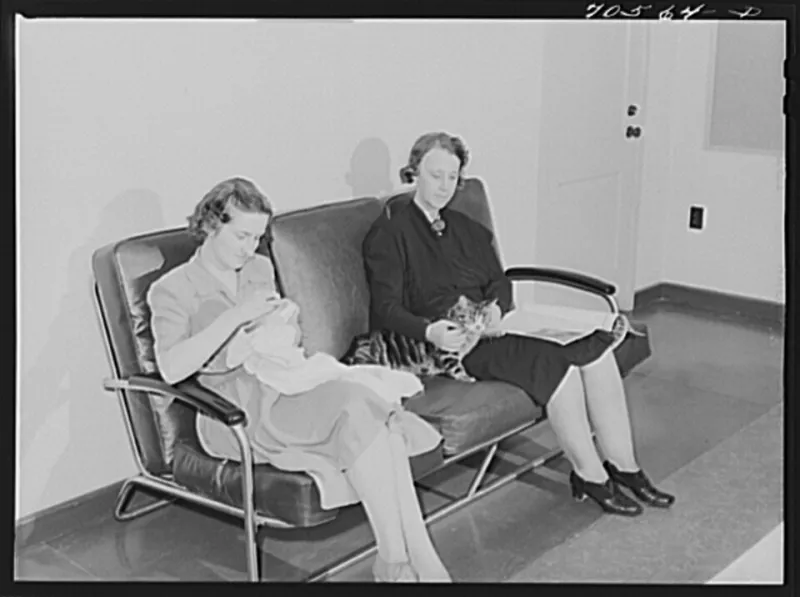
Photo: Russell Lee, Public domain, via Wikimedia Commons
There's a particular kind of power that doesn't announce itself. It doesn't show up in the meeting minutes or get its name etched into a cornerstone. It works through phone calls made from kitchen counters, through casseroles left on doorsteps, through the quiet insistence that this block will be okay even when every sign says otherwise. In Hyde Park, that power had a face — thousands of them, actually — and most of them belonged to women who never once asked for a thank-you.
This isn't a story about absence. It's a story about presence so constant, so foundational, that it became invisible the way wallpaper becomes invisible. You stop seeing it. But pull it down, and the whole room changes.
The Boarding House as a Blueprint
Long before Hyde Park had the community organizations and neighborhood associations that dot its landscape today, it had boarding houses. And boarding houses, more often than not, had women running them.
These weren't just rooms for rent. They were intake systems for people arriving in Chicago with nothing but ambition and a suitcase. Landlords managed properties. Boarding house keepers managed people — their meals, their mail, their morale, their introductions to the right neighbor at the right moment.
Historical records from the early twentieth century show dozens of women listed as boarding house operators in Hyde Park's census data, many of them widows or single women who had turned domestic necessity into something closer to civic infrastructure. They knew who was looking for work and who was hiring. They knew which church had the best network and which doctor would see you without asking too many questions about payment upfront.
"My great-grandmother ran a house on Woodlawn for almost thirty years," says Denise Carver, a lifelong Hyde Parker now in her sixties. "She knew everybody. When people talk about community back then, they're really talking about her — and women like her — whether they know it or not."
Mentorship Without a Program Name
Before mentorship became a nonprofit category with measurable outcomes and grant applications, it was just something certain women did because they saw a young person drifting and decided that wasn't acceptable.
Talk to enough longtime Hyde Park residents and a pattern emerges: a teacher who stayed late, a church mother who made sure you had bus fare, a neighbor who handed you a book and then expected a conversation about it the following Sunday. None of these women were running formal programs. They were just paying attention — which turns out to be one of the rarest and most powerful things a community can offer.
Marcus Webb, who grew up in Hyde Park in the 1970s and went on to become an educator himself, remembers a woman named Mrs. Eloise Tatum who lived three doors down from his family. "She wasn't a teacher. She wasn't a counselor. She was just — present. She knew every kid on that block by name, by grade, by what they were struggling with. If you were slipping, she noticed before your own parents did sometimes."
He pauses. "I don't think she thought of it as community work. I think she just thought of it as being a neighbor. But the effect was the same."
The Network No One Mapped
One of the most striking things about researching Hyde Park's women organizers is how deliberately informal their networks were. Formal organizations left records — minutes, membership rolls, annual reports. Informal networks left almost nothing, which is exactly why they've been so easy to overlook.
But informal doesn't mean unstructured. The women who organized Hyde Park's social fabric operated with remarkable consistency and intentionality. They knew who had a car and could drive someone to a doctor's appointment. They knew which families were quietly struggling and needed groceries without the embarrassment of asking. They coordinated school supplies drives through phone trees before anyone had a name for that kind of thing.
Dr. Yolanda Simms, a historian at a local university who has spent years documenting Hyde Park's social history, describes these networks as "the connective tissue of the neighborhood."
"Official institutions are the skeleton," she explains. "But skeletons don't move on their own. You need tissue, muscle, coordination. That's what these women provided. The neighborhood literally could not have functioned without them, and yet they are almost completely absent from the historical record."
Part of her ongoing research involves oral history interviews — sitting down with elderly women and their descendants to reconstruct what those networks actually looked like, how they operated, and what they accomplished. It's painstaking work, she says, because you're often rebuilding something from memory rather than documentation.
"The stories are there," she says. "You just have to know to ask for them."
What Got Built
It would be easy to frame this as a story about what these women didn't get — the credit, the recognition, the institutional power. And that's real. But it's worth pausing on what they did get: a neighborhood that worked.
The block clubs that protected Hyde Park's residential character during periods of intense development pressure? Women organized and sustained most of them. The informal scholarship networks that helped working-class kids access University of Chicago resources? Women built those relationships, one conversation at a time. The cultural continuity that kept traditions alive through waves of demographic change? Women carried that, in their kitchens and church halls and front yards.
Some of those institutions have since been formalized, named, given budgets and executive directors. The women who seeded them often don't appear in the founding narratives. That's a loss — not just for historical accuracy, but for the living community, which loses the ability to understand its own origins.
Telling It Now
There's urgency in this conversation that feels particular to this moment. The women who built Hyde Park's invisible architecture are aging. Some are gone. The ones who remain carry knowledge that exists nowhere else — not in any archive, not in any database, not in any official history.
"My mother could tell you the story of every family on her street going back fifty years," says Angela Booker, whose mother grew up in Hyde Park and still lives there. "She knows who helped who, who feuded with who, who made sure the lights stayed on in certain households. That's not written down anywhere. It's just in her."
Angela has started recording conversations with her mother. Slowly. Without a formal plan. Just showing up with her phone and letting her mother talk.
It's not so different, really, from what those women were doing all along — showing up, paying attention, making sure something important didn't disappear.
Hyde Park has always been a neighborhood of storytellers. The trick now is making sure the stories that got left out of the official version finally get told — out loud, on purpose, before the people who hold them are gone.
Because the room didn't run itself. It never did.